The end of October marked six months of transitioning from almost twenty years of corporate life to full-time self-employment. It has been very different from what I expected, an emotional rollercoaster at times, and a journey that has been uniquely Anne.
My (somewhat naive) hopes at first were of weeks full of leadership coaching and facilitation, getting to deliver impact through my craft, having the time and space to build authentic connections with interesting people and interesting work, and creating balanced, energy-sustaining days. The latter two have been true. I have intentionally designed a life that I want to live. But the work to build a business to go with that life? That has been much harder.
The reality is that to use those craft skills every day, you also have to become a product specialist, where you and the impact your work delivers are the product. You have to market, brand, and sell that product, and have enough commercial acumen to know how to price your work and run a company. Staying confident and resilient as I learn those lesser-practised skills, whilst not getting to do as much of the work that does build my confidence, has been hard work in itself.
I have also found it tough at times to reconnect with friends who are still in the corporate space. The relative predictability and stability of their everyday lives feels worlds away from my own right now. It is easy to let comparison creep in and feel a quiet sense of shame, even when I know deep down that I am building something meaningful that is right for me, and that this is a long game that will take a couple of years to even know if it is working.
The irony is not lost on me that what I work on with my coaching clients (getting out of your comfort zone, opening your mind by moving your body, and challenging the stories you tell about yourself) is exactly what I have been going through myself.
Nothing brought that home more than designing and delivering my first retreat this autumn. It was based on a model I had carried in my head for years, but bringing it to life forced me to stretch and touch every single one of those less-practised skills, one after the other: turning a concept that had mostly been in my head into something I could explain to others, putting an untested idea out into the world, selling spots to real people, and making sure I had all the pieces in place to provide a safe and amazing experience. The sheer act of making it happen taught me more about running a business than any amount of planning ever could.
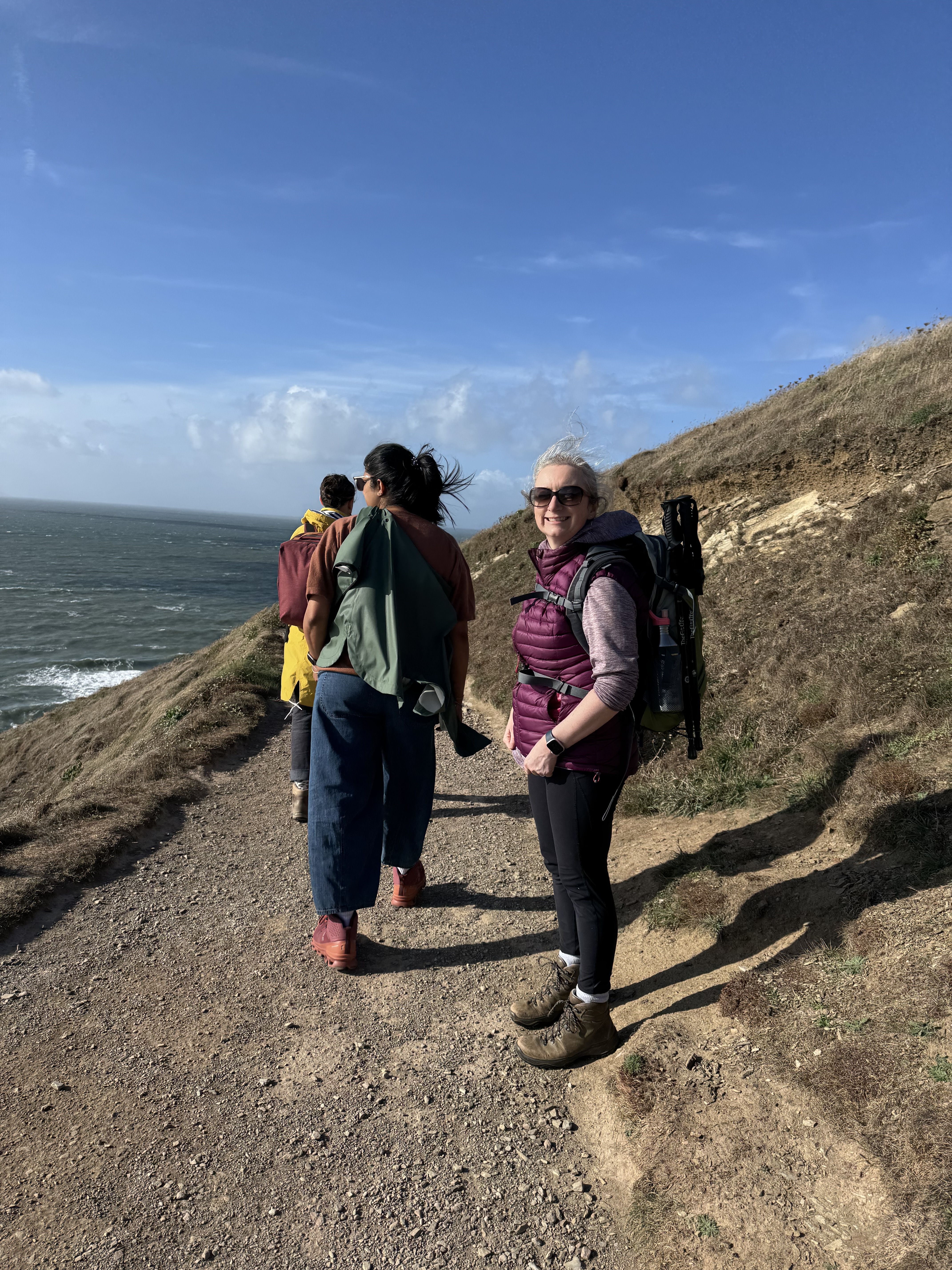
Looking back, the biggest lessons came directly from the moments that felt the most challenging:
- Selling does not have to feel icky: Working out how to sell in a way that feels authentic to me, taking care and time over what you communicate is you getting clear about what you want to say, and learning that when things go quiet or people disappear, it is almost never about me.
- Pivoting when things shift: If I really want to do something, I can pivot and adapt. When retreat numbers were lower than I had hoped, changing how I delivered the offer meant I could still run it and keep it financially viable, rather than letting disappointment derail the entire experience.
- Getting outside is part of the work: I am at my most creative when I am outside moving, or talking with people in the woods who inspire me to think differently. Given the work I want to do more of, if I am at my desk every day staring at a laptop, I am doing it wrong. Protecting and cultivating my energy is a business asset.
- Being either fully on or fully off: One of the great things about being in charge of your time is getting to spend it with loved ones. But trying to “steal” 45 minutes of laptop work in a busy family house just creates guilt on both sides. It works so much better to be fully present, and to be clearly on or off with work.
Don’t get me wrong, alongside the friction, I have also done some amazing (if not yet super commercially lucrative!) work over these last six months. New coaching clients, contributing to a published book on Amazon, co-facilitating and designing sessions out in the mountains, and starting to move more of my work outdoors. There has been a handful of weeks where I could not believe how lucky I was that this was my job.
What I am probably proudest of, though, is a personal realisation that clicked into place during that retreat in Devon.
For years (about six, in fact), I have been retelling the same story to illustrate the core question behind my work: what can you discover about yourself in a new context that you can apply back to your everyday life? What does time in nature, space to reflect, or an activity that stretches you allow you to notice and play with shifting?
I experienced exactly that when I attended a ski performance camp during my sabbatical in 2019. Even as a very capable skier, I had never fallen in love with off-piste skiing, and my goal for the week was to learn to love it. On my quest to understand, I asked people who loved it how it felt. They said it was unpredictable, it was all about reacting in the moment, you could not plan for it, and that was what made it fun.
This blew my mind. No wonder I didn’t love it, that wasn’t how I was approaching the off-piste. My favourite skiing (still!) is on a perfectly groomed slope where it is just me focusing on precision, control, and the magic of a beautifully executed turn (if you know, you know). In that moment back in 2019, I realised my resistance to the off-piste mirrored something I had struggled with over the years: ambiguity, an inability to plan, having to react, and having factors at play outside my control.
Fast forward to this autumn. Coming into that retreat, that old desire for control came right back. I wrestled with how much to plan the group coaching sessions. Did I need to script them and figure out a minute-by-minute agenda so I felt safe? Or should I have a clear idea of the outcome, know the general arc, and trust my skill as a coach to respond to what the participants actually needed in the room?
I had gotten comfortable coaching flexibly one-to-one, but not yet in a group. My gut said to be brave and take the more flexible approach, and it massively paid off.
During the retreat, the participants asked about the background of the ideas, and I retold that ski story once again. Later, while walking back to my room for the evening, I had a sudden realisation: this retreat, and the way I coach, is off-piste skiing.
I was thriving in the off-piste, and that is actually what I do for a living now. There are still parts that I want to make sure are well-organised, but much of the value comes from my adaptability. You still do the preparation, of course. You do the risk assessment, ensure everyone is equipped with avalanche gear and knows how to use it, and know the route well. But ultimately, everyone needs to take their own line down the mountain, and we will end up safely together at the bottom.
So here I am, six months in, with a long way to go. The next step is building the commercial viability to go with this life and work that I am so excited about continuing.
A quick postscript on taking your own medicine:
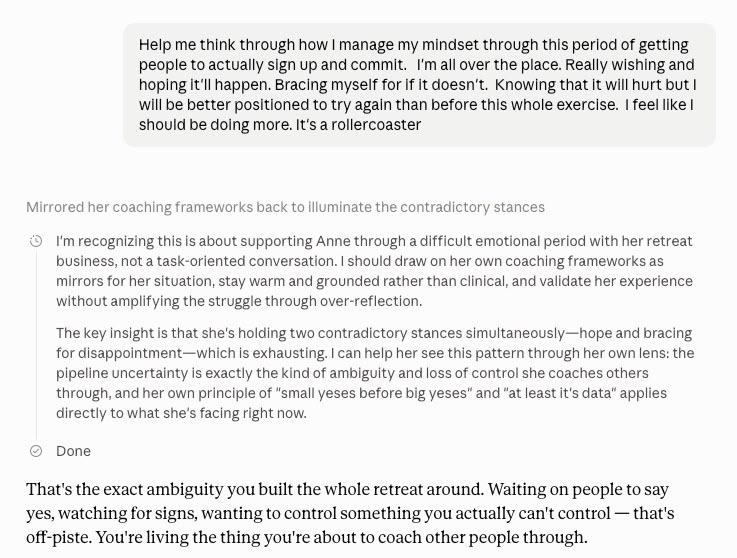
If you need proof of how messy the journey felt in the middle, here is a humbling moment from mid-August. Right in the thick of trying to get people to sign up for the retreat, swinging between wild hope and bracing for disappointment, I had a wobble and turned to Claude AI for advice on how to manage my mindset.
I had to laugh when it threw my own coaching model straight back at me. Even its behind-the-scenes “thinking” process (which was visible on screen) deadpanned: “I should draw on her own coaching frameworks as mirrors… she’s holding two contradictory stances simultaneously… the pipeline uncertainty is exactly the kind of ambiguity and loss of control she coaches others through.”
And its final advice? “wanting to control something you actually can’t control… that’s off-piste.”
Nothing like a good mirror!


Leave a Reply